
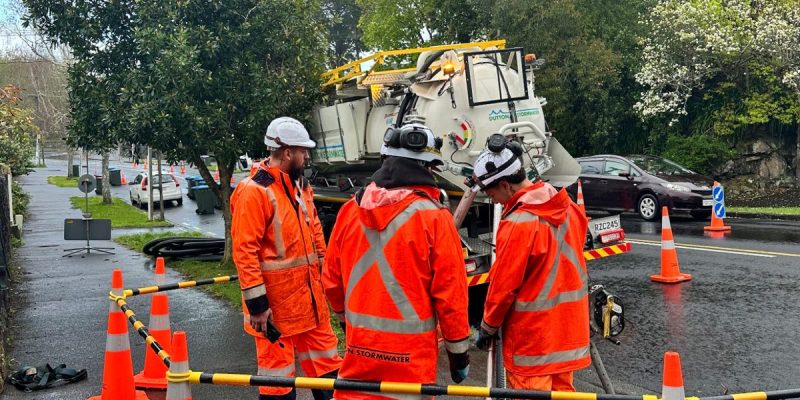
Dutton Stormwater services three stormwater tunnels beneath central Auckland, cut through volcanic rock and running up to 170 metres long.
Maintaining these critical assets requires specialist planning, experience and strict safety procedures. Descending seven metres underground, the tunnels feel more like caves than conventional infrastructure. Their biannual inspections can only take place during carefully selected weather windows and require full ventilation systems, confined-space procedures and specialist crews.
These assets quietly protect surrounding communities, businesses and waterways during major rainfall events. Most people will never see them.
Yet by 2050, hidden assets like these may become some of the most important infrastructure in New Zealand.
Not because stormwater systems are changing fundamentally, but because the conditions around them are. Climate pressures, insurance scrutiny, compliance expectations and resilience planning are all reshaping what good asset management looks like.
The facilities managers who succeed in 2050 are unlikely to be the ones with the newest technology. They will be the ones who understand their assets, maintain them consistently and make good decisions before problems emerge.
The rain has stopped following the brief
The trend is already underway.
IAG reports that damaging storms have gone from arriving about every 19 days to about every eight. Drainage systems designed around historical rainfall patterns are being tested more frequently and in ways they were not always designed to accommodate.
Many facilities managers are responsible for stormwater assets installed decades ago, often with limited historical information available. The infrastructure remains the same, but the operating environment is changing around it. As weather events become more frequent and intense, the margin for error becomes smaller.
Looking toward 2050, resilience will increasingly depend on understanding asset condition before a storm arrives, not discovering problems during one. The organisations best prepared for future weather challenges will be those with visibility over the assets they already own.
Your insurer may become your next asset reviewer
As climate risk becomes a bigger business concern, infrastructure performance is becoming more visible outside operational teams.
Insurers are moving from sector-wide assessments toward site-level evaluations, meaning two similar organisations can receive very different terms based on their own exposure and asset management practices.
Increasingly, organisations are being asked to demonstrate how they identify, manage and reduce stormwater risk. The evidence often sits in routine maintenance records. Inspection dates. Clearance records. Before-and-after photographs. Condition assessments. Work orders. Sign-offs.
Today these records support maintenance decisions. By 2050, they may become equally important in demonstrating organisational resilience and responsible asset stewardship. For facilities managers, good record-keeping is no longer simply administration. It is part of risk management.
Prevention will become a competitive advantage
The lesson for asset owners is straightforward: prevention is usually more cost-effective than recovery.
Facilities managers experience this reality every day.
A blocked outlet discovered during a routine inspection may take hours to address. The same issue identified during a flood event can disrupt operations, damage property and create significant recovery costs.
By 2050, organisations are likely to place increasing value on resilience, business continuity and long-term asset performance. Stormwater systems will not be judged solely on whether they function, but on how reliably they continue operating under pressure.
Success will still be measured by what does not happen: flooding, pollution, asset failures and disruption.
Green infrastructure is infrastructure
One of the biggest shifts between now and 2050 may be how organisations think about green infrastructure.
Raingardens, swales and treatment landscapes are often managed as landscaping assets when they are actually working components of the stormwater network.
They slow flows, improve water quality and support environmental outcomes before runoff reaches traditional drainage systems.
The challenge is that they can easily disappear from asset registers and maintenance programmes.
Add increasingly variable cycles of drought and downpour, and these assets face growing pressure. Blocked inlets, clogged growing media, compacted soil and declining plant health can gradually reduce performance without attracting attention.
The facilities managers who get the most value from green infrastructure by 2050 will not be those who simply install it. They will be the ones who manage it. Register it. Inspect it. Maintain it. Budget for it. Treat it with the same discipline as the pipe beside it.
Technology will improve visibility, not replace ownership
By 2050, facilities managers are likely to have access to far greater levels of asset intelligence than they do today.
Sensors can provide real-time monitoring. Drones can improve inspection access. Digital asset registers can consolidate maintenance histories. Predictive tools may help identify issues before they become failures.
These developments will be valuable. But technology does not replace the fundamentals of good asset management. A sensor can tell you an asset is performing poorly. It cannot clear the blockage. A dashboard can identify a risk. It cannot assume ownership of it.
The future of stormwater management will involve better information, but success will still depend on people making informed decisions and acting on them.
Three decisions that shape stormwater resilience by 2050
-
Know what you own
Pipes, tunnels, ponds, treatment devices, raingardens and outlets.
If it stores, moves, treats or controls stormwater, it should be included in your asset register with an understanding of its condition, criticality and maintenance requirements.
-
Protect your maintenance opportunities
Confined-space and low-lying assets can only be accessed during suitable weather conditions.
As storm events become more frequent, those maintenance windows may become harder to secure. Planning inspections early and prioritising critical assets will become increasingly important.
-
Build records that stand the test of time
Good records support compliance, future maintenance planning, organisational knowledge and risk management.
They also create continuity as teams, contractors and responsibilities change over time.
The more complete your records are today, the better prepared your organisation will be tomorrow.
Boring is the goal
The best-performing stormwater asset in your portfolio in 2050 will probably be the one nobody talks about. Not because it is unimportant. Because it works. It has been inspected. Maintained. Documented. Understood.
The technology supporting stormwater management will continue to evolve. Climate pressures will continue to grow. Stakeholder expectations will continue to change. But the fundamentals are unlikely to be different.
Protecting people, property and waterways will still depend on the work that happens long before the storm arrives.
And that starts with looking after the assets most people never see.
Get in touch today to discuss how we can help maintain your stormwater assets: info@duttonstormwater.co.nz
0800 115 557